
● Concepts
Research Process
The terms Satellite Coast and infrastructural adjacency help us think through and untangle the dynamics of technological, socio-economic, and cultural activity in central California related to a rapidly expanding industry of rocket launches and satellite deployments. How are diverse human and more-than human communities impacted by large infrastructural projects sited directly adjacent to where they live, work, learn, and engage in cultural practices?
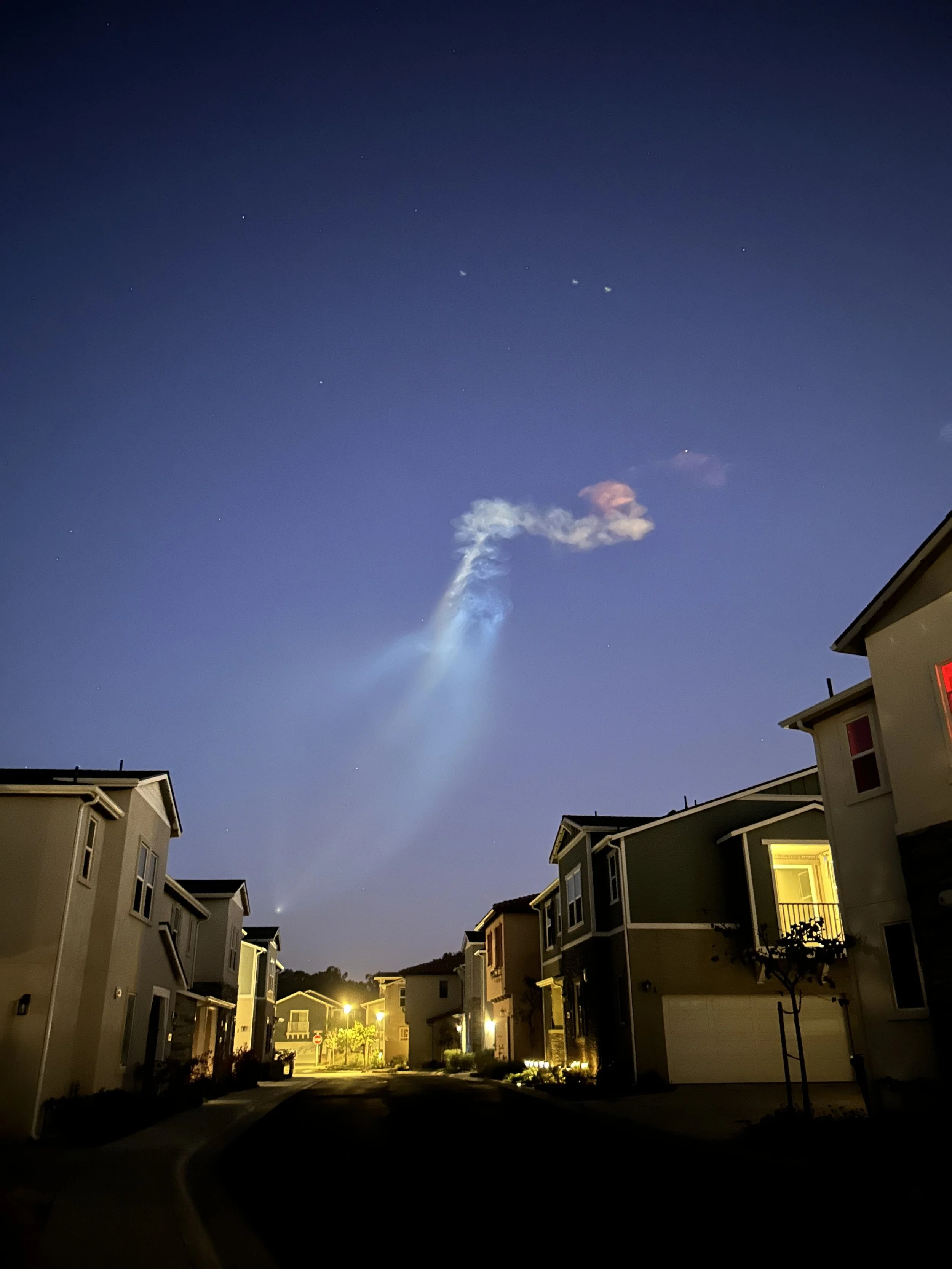
Satellite coast: A specific zone of technological, socio-economic, and cultural activity in central California, where agriculture, aerospace, and prison industries converge on the unceded lands of Indigenous Chumash communities. The satellite coast includes space launch complexes on the Vandenberg base and the community of Lompoc. It extends as far south as Hawthorne where Falcon 9 rockets are manufactured and transported up the coast on freeways to Vandenberg’s hangars. The satellite coast also encompasses extensive oceanic domains off the central coast, some of which are designated as marine sanctuaries, as well as an aerial domain that stretches outward and upward as far as the eye can see.
Infrastructural adjacency: A concept that refers to the sociotechnical and spatial relations between large-scale infrastructural projects such as global satellite launching complexes and the surrounding communities, institutions, and ecologies.
● Vandenberg Space Force Base
Background
Hidden between the coastal bluffs of the Pacific Ocean and the Central Coast’s hills and on the ancestral lands of Indigenous Chumash peoples lies Vandenberg Space Force Base, one of only four active government spaceports in the United States.
Originally a US Army installation (1941-when), it became an Air Force base during the 1950s to support Cold War missile and space programs. Following a rigorous launch schedule during the Cold War, launch cadence at the base slowed to a crawl before accelerating again in the early 2020s, when the federal government began leasing Vandenberg’s Space Launch Complexes to commercial operators.
During the last decade, the number of commercial satellite launches from the Vandenberg Air/Space Force Base has skyrocketed, primarily driven by aggressive growth by SpaceX.
SpaceX launches have increased from a handful of launches annually between the years of 2016-2020 to an average of one launch every five days in 2025. Environmental scientists have expressed concern about the impact of launch-related carbon emissions and black carbon on the atmosphere. Astronomers have complained about the unprecedented level of orbital congestion impeding telescopic views of deep space. Space archaeologists worry about the accumulating amount of space junk in orbital domains.
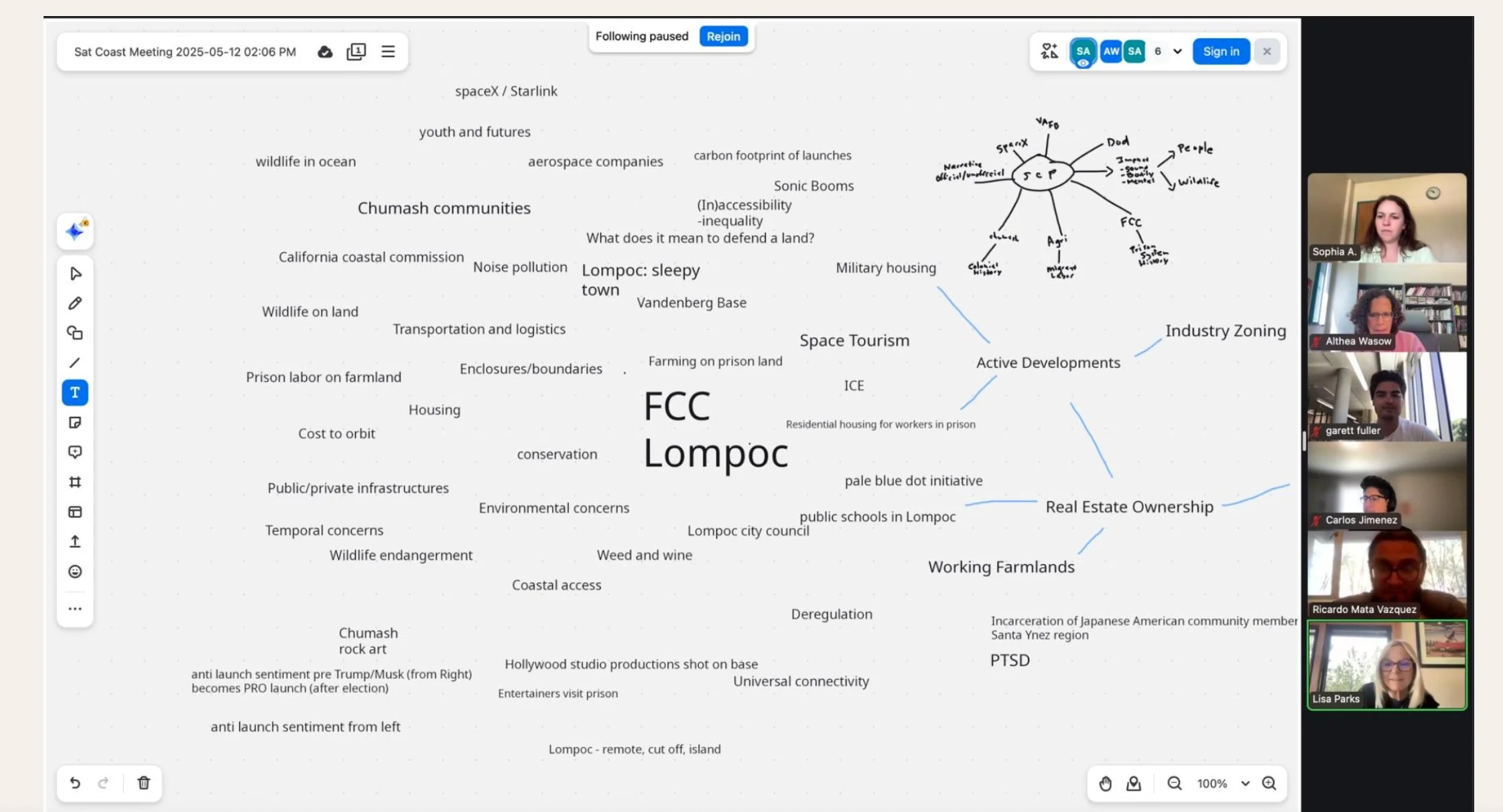
Central to this project, however, is the impact felt locally by those who live, work, and hold ceremonies in the areas directly adjacent to launch infrastructure, including Lompoc’s farms and ranches, wetlands and coastlines, school and prisons, neighborhoods and parks. Our project engages with and learns from the perspectives of overlooked constituencies of a region we call the Satellite Coast.
Research Methods
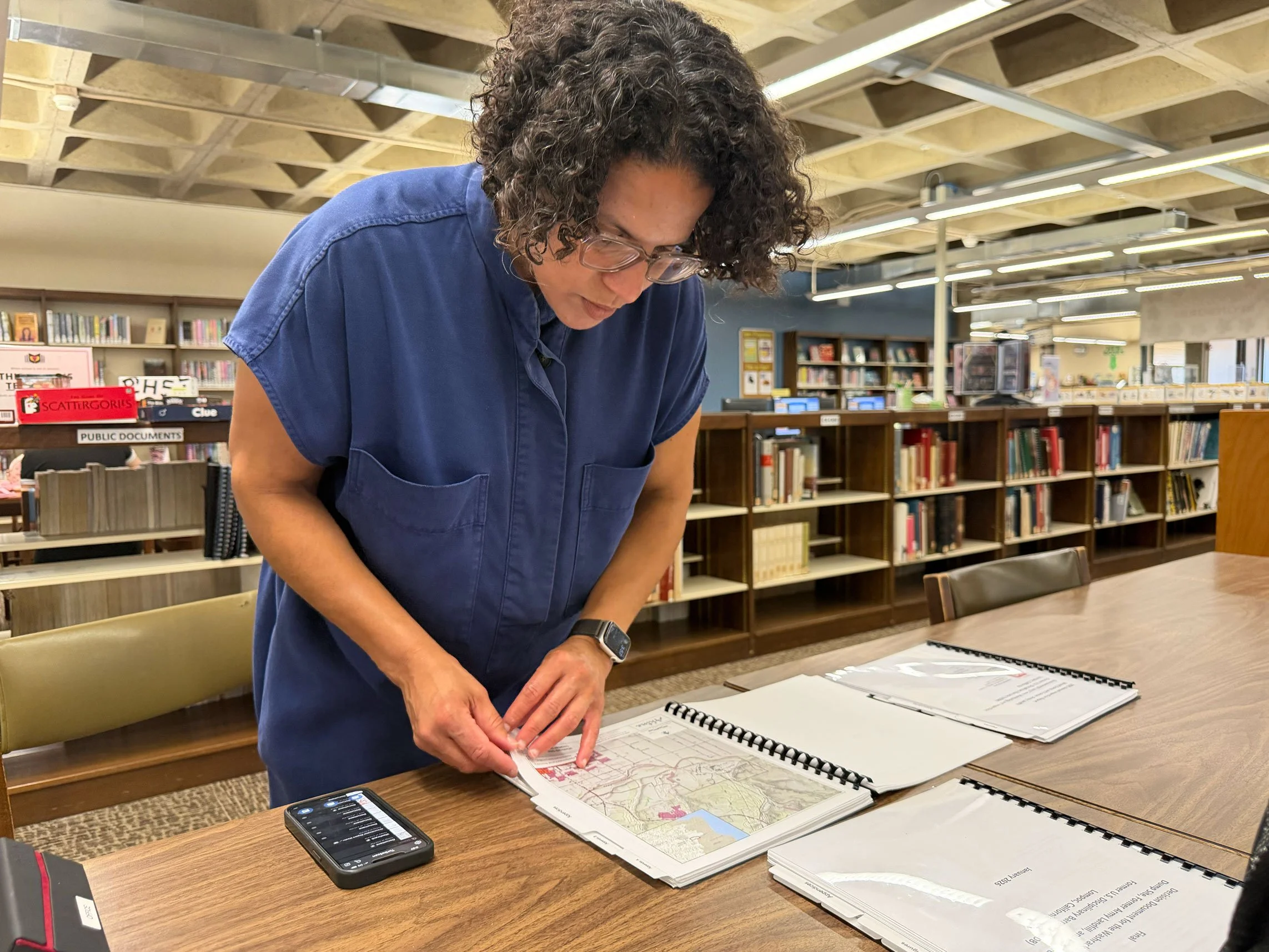
Archival research of materials held at the Lompoc Historical Society and online sources
Fieldwork including dozens of day-long research trips and a two-week extended fieldwork trip to Lompoc between 2023-2026
Interviews and focus groups with a diverse range of community members from Lompoc, Guadalupe, and Santa Ynez
Participant observation at Lompoc and Vandenberg Space Force Base community meetings
Audio-visual documentation of rocket launches from a wide range of vantage points in Lompoc, Goleta, and Santa Barbara; and of sites related to each case study and the surrounding area
Project Timeline
Summer 2023
Preliminary research for Satellite Coast began in Summer of 2023 when University of California, Santa Barbara Distinguished Professor, media historian and theorist Dr. Lisa Parks — whose prior research had focused on satellite technologies and media globalization — turned her attention to the growing industry of rocket launches and satellite deployments at Vandenberg Space Force Base just fifty miles north of UCSB’s campus.
Fall 2023
Graduate student researcher Tara Plath (FAMST) and undergraduate research assistant Rana Zahabi are hired to help conduct preliminary research for a proposal to the National Science Foundation’s Science and Technology program. Cumulatively, we make ten trips to Lompoc, witnessed and recorded six satellite launches, visited SpaceX’s launch site at the Vandenberg base, conducted preliminary interviews with aerospace workers, leaders of Chumash organizations, scientists from NOAA, environmental scientists, prison activists, and leaders of the Lompoc Historical Society. We also undertook background research about the Vandenberg base, the lands it sits on, and the communities that surround it.
Fall 2023
Principal Investigator Lisa Parks invites Assistant Professor Althea Wasow (University of California, Santa Barbara) and Associate Professor Carlos Jimenez Jr. (University of Denver) to join the project as Co-Principal Investigators (Co-PI).
January 2024
We apply for a National Science Foundation Science and Technologies (STS) Grant.
July 2024
The NSF awards Satellite Coast with a two-year STS Grant
Fall 2024
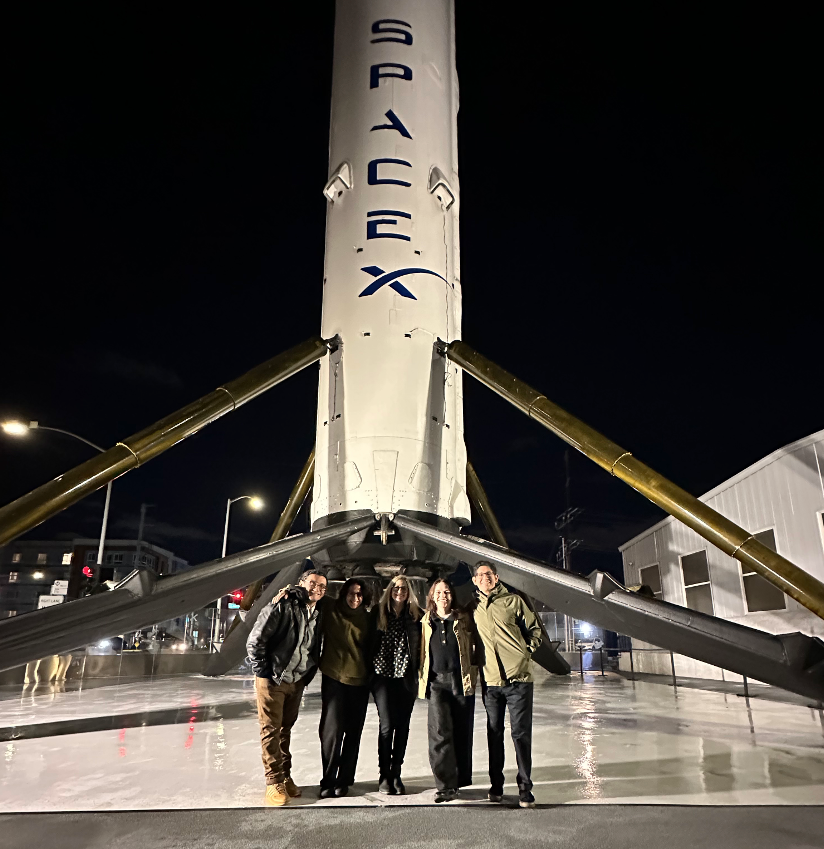
The team conducts research into SpaceX and Starlink’s operations and launch history at Vandenberg.
April 25, 2025
The NSF award is rescinded/cancelled per an executive order targeting awards whose proposal language included words related to diversity, equity and inclusion (D.E.I.).
The team continues working and applies for alternative funding from the UCSB Blum Center on Poverty, Inequality, and Democracy.
July 2025
The team relocates to Lompoc for four weeks of intensive fieldwork, recording over 90 interviews with community members.
The NSF Grant gets reinstated per a preliminary junction issued by the U.S. District Court for the Northern District of California in Case No. 25-cv-04737, requiring that NSF reinstate awards to all University of California researchers.
November 2025
The team presents preliminary findings at the American Studies Association annual conference in Puerto Rico.
Winter 2025
Preliminary interviews are conducted with active and former public servants and civilian base contractors. Archival research on archaeological excavations continues.
January – May 2026
We analyze interview transcripts.
February 17, 2026
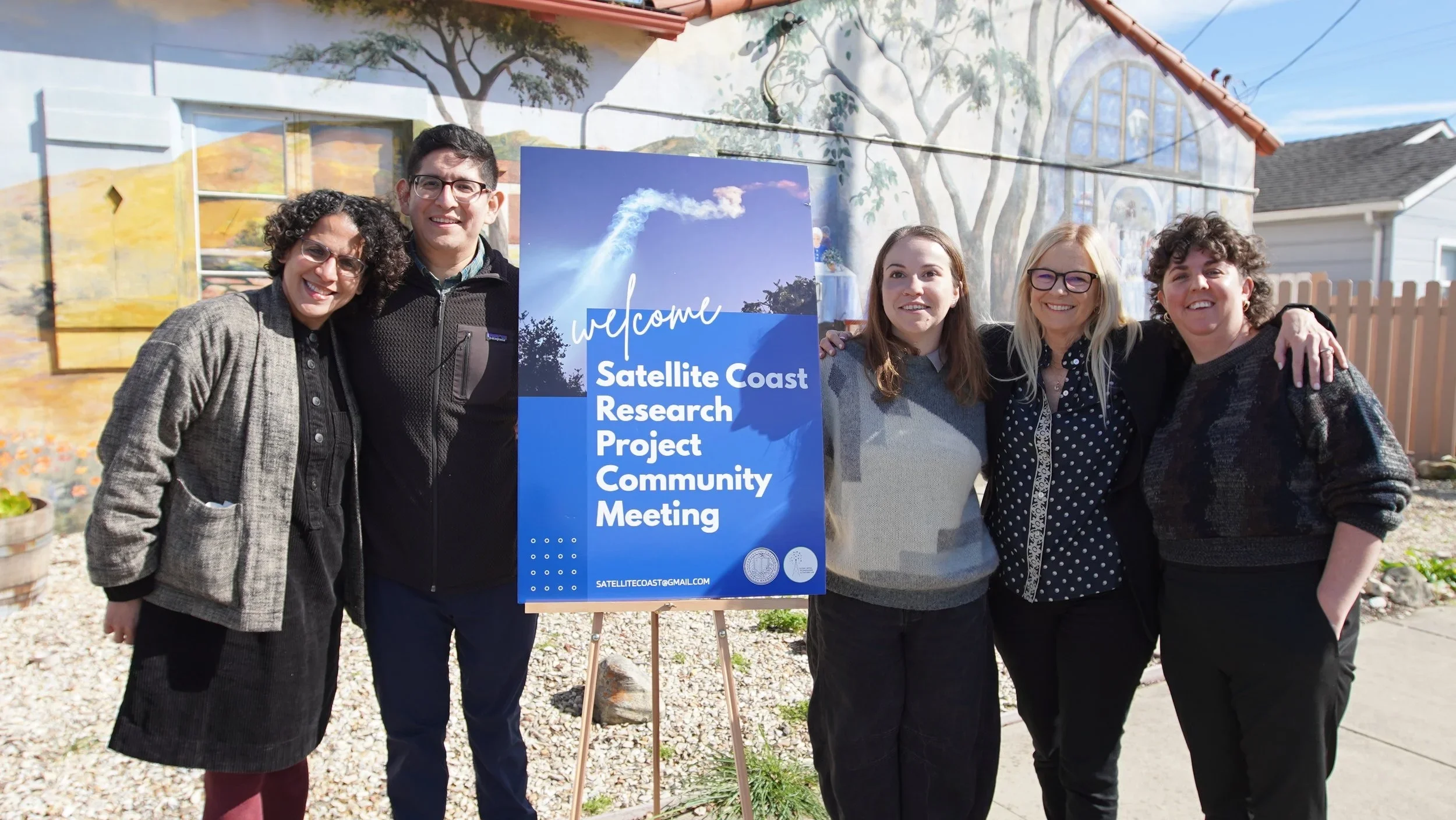
We present our preliminary findings at a community meeting at the Lompoc Alpha Club, and receive feedback from project participants and others.
May 23, 2026
We host a drawing workshop at the Lompoc Library and invite Lompoc Residents to think creatively with us about their experiences of living adjacent to VSFB.